NMEA 2000 is the CAN network on almost every modern boat: chartplotters, engines, instruments, autopilots, AIS, tanks and batteries share one powered backbone. It uses the DeviceNet connector — the 5-pin M12 “Micro-C”, or the larger 7/8" “Mini-C” on heavy backbones — with 12 V on the same cable as the data.
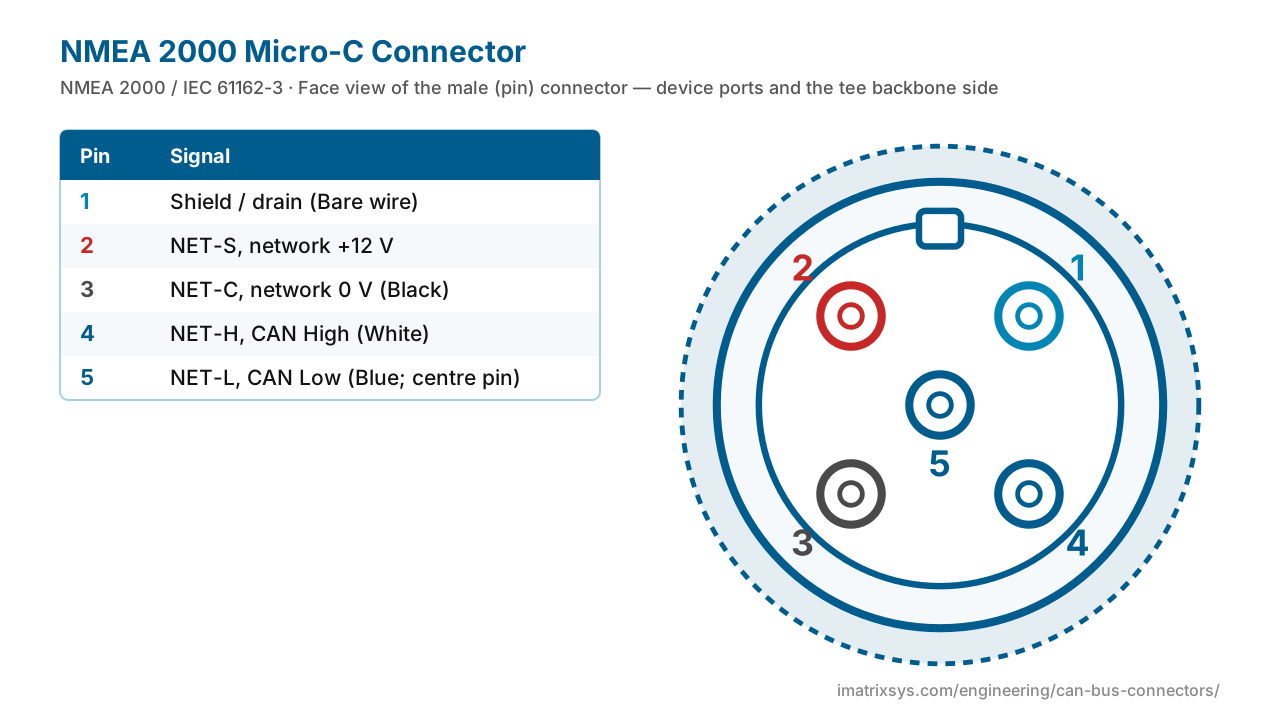
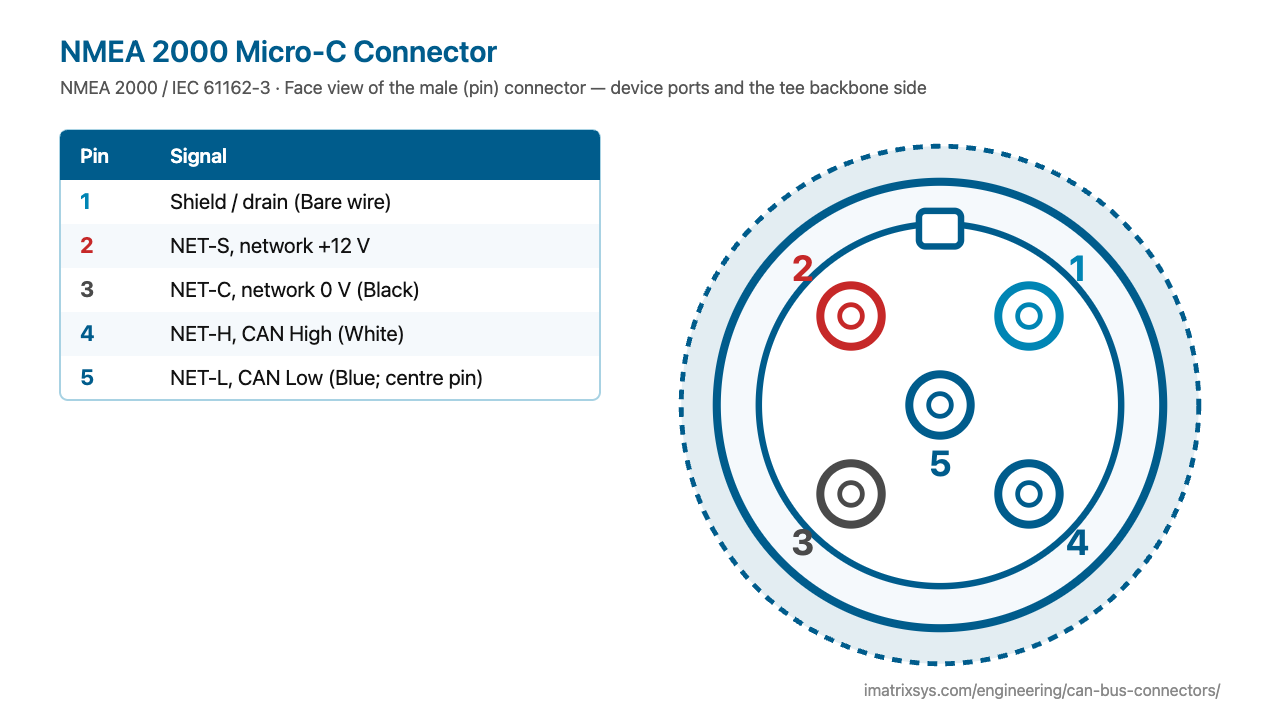
Pin 5 is the centre pin and carries NET-L (CAN Low); 4 is NET-H (CAN High), 3 NET-C (0 V), 2 NET-S (+12 V) and 1 the shield. Switch to the female face — the tee’s drop port — to see the mirror image. The Mini-C uses the same numbers and colours on a ring with no centre pin.
Face view of the male (pin) connector — device ports and the tee backbone side
| Pin | Signal |
|---|---|
| 1 | Shield / drain — Bare wire |
| 2 | NET-S, network +12 V — Red; 9–16 V at every device |
| 3 | NET-C, network 0 V — Black |
| 4 | NET-H, CAN High — White |
| 5 | NET-L, CAN Low — Blue; centre pin |
| Bit rate | 250 kbit/s CAN |
|---|---|
| Micro-C pins | 1 shield, 2 NET-S +12 V, 3 NET-C 0 V, 4 NET-H, 5 NET-L (centre) |
| Wire colours | Bare shield, red NET-S, black NET-C, white NET-H, blue NET-L |
| Power | 9–16 V at every device; 1 LEN = 50 mA |
| Backbone | 100 m on light / Micro cable; up to 200 m on Mid / Mini (some vendors allow 250 m) |
| Drops | 6 m each, 78 m in total; 50 devices per network |
| Termination | 120 Ω at each end of the backbone — about 60 Ω with the power off |
The National Marine Electronics Association was founded by electronics dealers in 1957. Its first data standard, NMEA 0183 (1983), is a 4800-baud serial link with one talker and several listeners. In 1999 a group of manufacturers began work on a faster, multi-talker successor built on CAN and on SAE J1939’s higher layers; the result, NMEA 2000, appeared around 2000–2001 and runs at 250 kbit/s with power on the same cable. The IEC published it as IEC 61162-3 in 2008. Products that use it must be NMEA-certified.
NMEA 2000 did not invent a connector: it adopted the DeviceNet physical layer, so its cables, tees and M12 connectors are electrically the same as DeviceNet’s — but at 12 V, not 24 V. Ethernet data such as radar and video sits on a separate network (NMEA OneNet, released in 2020).
One continuous backbone runs through the boat, with a 120 Ω terminator at each end — one male, one female. Each device joins it through a tee and a drop cable of no more than 6 m. There are no branches or stars. The backbone is powered at one point through a power tee; no data flows if the backbone is unpowered, even when the displays are on. Ground NET-C and the shield at that one power point only.
Tees are female on the drop port, and cordsets are male at one end and female at the other. Devices usually have a male port.
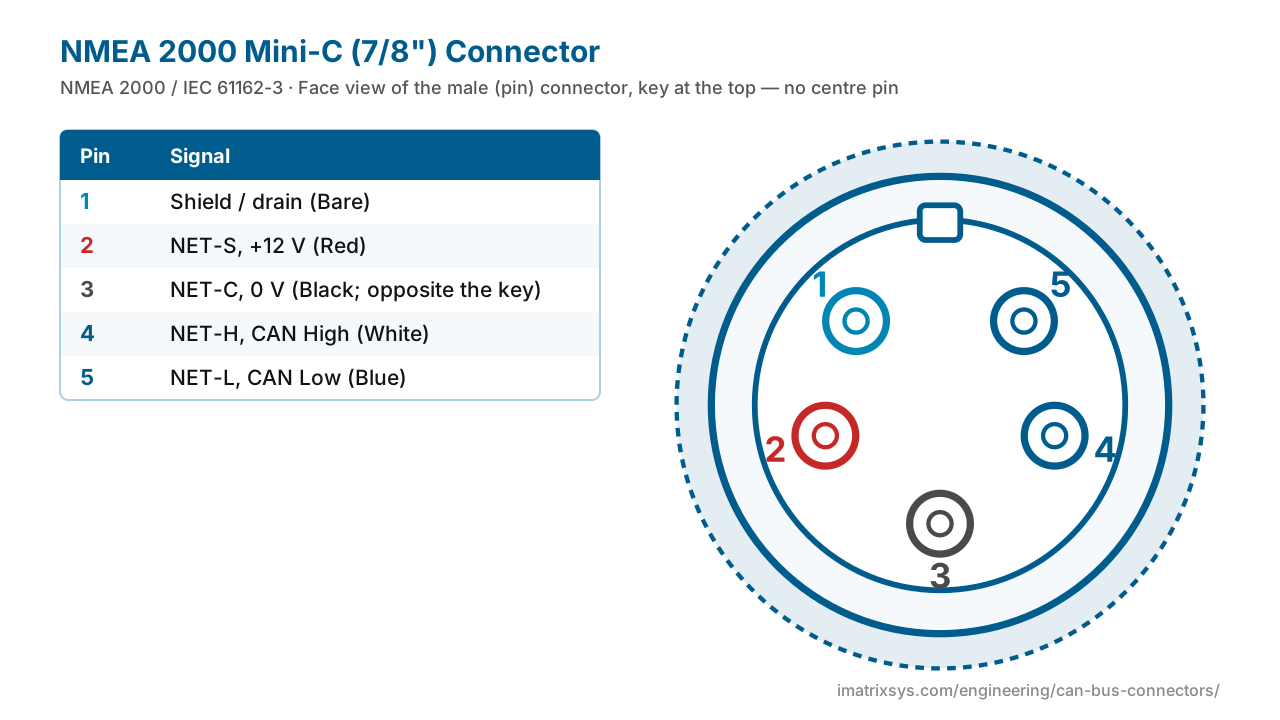
Larger vessels run the backbone on Mini (7/8"-16UN) cable, which carries more current (8 A versus about 3–4 A for light Micro cable) with less voltage drop, and reduce to Micro-C at the tees. The Mini-C has the same five signals and colours, but no centre pin: the five contacts sit on a ring with pin 3 opposite the key. The diagram below shows the male face.
Raymarine SeaTalk NG and Simrad / B&G SimNet are NMEA 2000 with their own plugs. Their pin assignments are not published, so use the makers’ adaptor cables rather than re-wiring: Raymarine A06045 (NMEA 2000 female to SeaTalk NG spur, for a standard device on a SeaTalk NG backbone) and Simrad 24005729 (SimNet to Micro-C male, for a SimNet device on a standard backbone). Keep one backbone with exactly two terminators across both sections. Garmin and Lowrance use the standard Micro-C.
Every device must see 9–16 V. Industry practice: under 1.5 V of calculated drop the power tee can go anywhere; between 1.5 V and 3.0 V it must be near the middle of the backbone; above 3.0 V use heavier cable or split the load. (Garmin’s own tool allows 1.67 V.)
Add up the LEN of every device (it is printed on each one) and check the voltage drop.
Choose any two connectors to get a pin-to-pin wiring diagram, with wire colours, which pins to leave unconnected, and the power and termination warnings that matter. Hover a wire to trace it.
Pick two connectors to draw the wiring. (Needs JavaScript.)
On the Micro-C (M12) connector: pin 1 shield, pin 2 NET-S (+12 V), pin 3 NET-C (0 V), pin 4 NET-H (CAN High) and pin 5 NET-L (CAN Low), which is the centre pin. The Mini-C uses the same numbering.
Bare for the shield, red for NET-S (+12 V), black for NET-C (0 V), white for NET-H and blue for NET-L — the same colours as DeviceNet cable. Some proprietary cables differ, so check by pin number.
Yes. SeaTalk NG is NMEA 2000 with Raymarine plugs. Use Raymarine’s adaptor cables, such as A06045 to plug a standard NMEA 2000 device into a SeaTalk NG spur, and keep one backbone with exactly two terminators.
NMEA 0183 is a 4800-baud serial link with one talker and several listeners. NMEA 2000 is a 250 kbit/s multi-talker CAN network with power on the same cable. They are not electrically compatible and need a gateway.
Feed 12 V into the backbone at one point through a power tee, from a fused, switched supply. Every device needs 9–16 V: keep the calculated voltage drop under 1.5 V, or under 3 V with the power tee near the middle of the backbone.
120 Ω, one at each end of the backbone. With the power off, a correctly terminated network measures about 60 Ω between NET-H and NET-L.
6 m per drop and 78 m for all drops together. The backbone can be up to 100 m on light / Micro cable.
It is built on the same 250 kbit/s CAN and J1939-style addressing, but uses its own marine messages. Connect an engine’s J1939 bus through an isolating gateway, not a straight cable.
Sources: Maretron Micro/Mid cable and connector cut sheet; Maretron Mini cable and connector cut sheet; Turck 7/8" DeviceNet connector contact assignment; Airmar NMEA 2000 field connector instructions; NMEA 2000 network design guide (Jack Rabbit Marine); Garmin: NMEA 2000 cable length and device limits; Garmin: NMEA 2000 power distribution; Actisense: 3 fundamentals of NMEA 2000 network design; Kvaser: NMEA 2000; Raymarine: DeviceNet to SeaTalk NG adaptor cables; NMEA: history; IEC 61162-3 (NMEA 2000); Wikipedia: NMEA 2000.
Last reviewed 2026-10-28. Pin assignments follow NMEA 2000 / IEC 61162-3; OEM variants are noted where we could verify them. Spotted an error? Tell us.
iMatrix designs and builds CAN, J1939 and OBD-II harnesses for OEMs and fleets, and our FleetConnect telematics devices plug straight into the 9-pin and OBD-II ports. Tell us the two ends and the quantity.