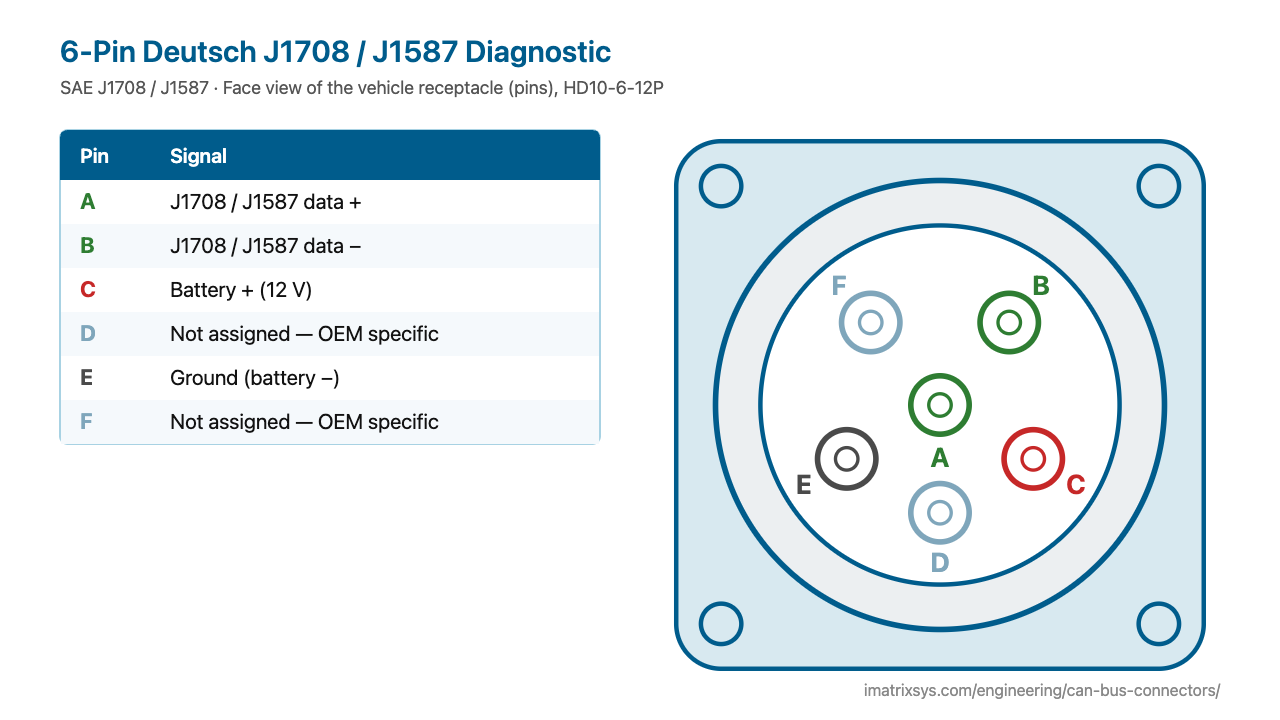
Before the 9-pin J1939 port, heavy trucks had a round 6-pin Deutsch diagnostic connector. It carries the SAE J1708 data link — a 9600 bit/s serial bus with J1587 diagnostic messages — plus battery power and ground. It has no CAN, which is the most important thing to know when you plug a modern tool or ELD into it.
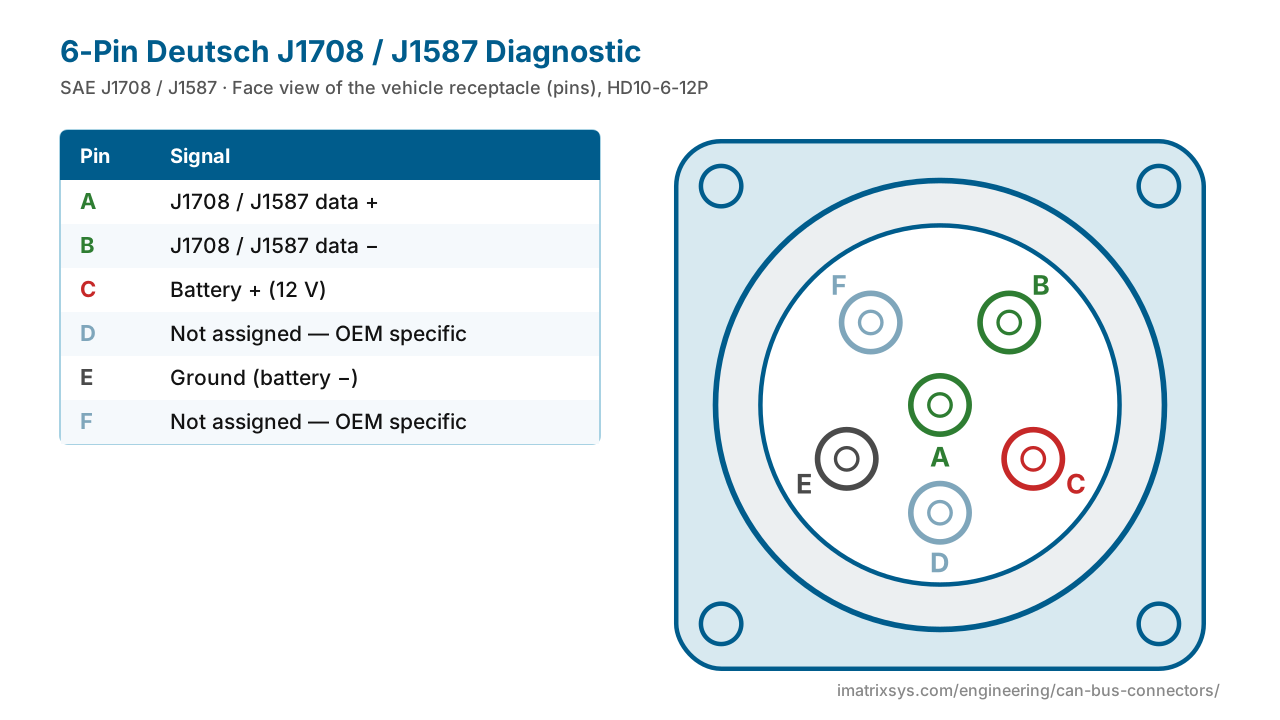
Pin A is the centre pin and carries J1708 data +; B is data −, C battery + and E ground. D and F are not assigned by SAE and are left to the manufacturer. Switch to the tool plug to see the mirror image.
Face view of the vehicle receptacle (pins), HD10-6-12P
| Pin | Signal |
|---|---|
| A | J1708 / J1587 data + |
| B | J1708 / J1587 data − |
| C | Battery + (12 V) |
| D | Not assigned — OEM specific |
| E | Ground (battery −) |
| F | Not assigned — OEM specific |
| Data link | SAE J1708, 9600 bit/s; J1587 (and J1922) messages |
|---|---|
| Pins | A J1708 +, B J1708 −, C battery +, E ground; D and F OEM specific |
| Truck side | HD10-6-12P receptacle with pins, usually grey |
| Tool side | HD16-6-12S plug with sockets; size-12 contacts |
| Network | Twisted pair, up to 40 m and 20 nodes; no terminating resistors |
| Fitted | From about 1995; replaced on most new trucks by the 9-pin between about 1998 and 2001 |
SAE issued J1708 in January 1986 as a common data link for heavy-duty vehicles, and J1587 in January 1988 as the message set on top of it. J1708 uses RS-485-style transceivers, but with bias resistors instead of terminators, at 9600 bit/s; messages are up to 21 bytes, each starting with a MID that identifies the sending module — 128 for the engine, 130 for the transmission, 136 for the brakes. Faults are reported as a PID or SID with a failure mode (FMI), the same FMI idea J1939 later reused.
The round 6-pin Deutsch port gave trucks a standard place to plug in a tool from about 1995. J1939’s much faster CAN network then took over, and new trucks moved to the 9-pin J1939-13 connector between about 1998 and 2001. Many later trucks still carry J1708 alongside J1939 — on pins F and G of the 9-pin connector.
A 6-pin to 9-pin adapter lets a modern 9-pin tool or ELD cable plug into an older truck. It carries J1708, power and ground — and nothing else, because the 6-pin port has no CAN:
| Signal | 6-pin (truck) | 9-pin (tool) |
|---|---|---|
| J1708 + | A | F |
| J1708 − | B | G |
| Battery + | C | B |
| Ground | E | A |
| CAN, shield, OEM | — | C, D, E, H, J not connected |
Through it, a tool can read and clear J1708 / J1587 codes and data, but it cannot reach J1939. The converter on this page draws the same wiring.
The 6-pin and 9-pin connectors cannot be cross-plugged: besides the different layouts, the 6-pin uses larger size-12 contacts.
Choose any two connectors to get a pin-to-pin wiring diagram, with wire colours, which pins to leave unconnected, and the power and termination warnings that matter. Hover a wire to trace it.
Pick two connectors to draw the wiring. (Needs JavaScript.)
A = J1708 data +, B = J1708 data −, C = battery +, E = ground. D and F are not assigned by SAE; some manufacturers use them. Pin A is the centre pin.
J1708 is a two-wire bus. On the 6-pin connector it is on A (+) and B (−); on the 9-pin J1939 connector it is on F (+) and G (−).
Yes, to plug a 9-pin tool or ELD cable into an older 6-pin port. It connects A to F, B to G, C to B and E to A, so it passes J1708, power and ground. It cannot add J1939, because the truck’s 6-pin port does not have it.
J1708 / J1587 is a 9600 bit/s serial bus on an RS-485-style pair, for up to 20 nodes over 40 m, with MID, PID, SID and FMI codes. J1939 is CAN at 250 or 500 kbit/s with SPN and FMI codes. They are electrically incompatible.
If its diagnostic port is the round 6-pin, the port only offers J1708 / J1587. A 9-pin port (black or green) carries J1939 on pins C and D, and often J1708 on F and G too.
The truck receptacle is HD10-6-12P (pins) and the mating tool plug HD16-6-12S (sockets), both with size-12 contacts.
Sources: Drew Technologies: Industry Connectors Reference (rev 1.5); Diesel Laptops: troubleshooting J1708 connections; TI AN-915: SAE J1708 physical layer; Kvaser: introduction to SAE J1708; Kvaser: introduction to SAE J1587; SAE J1708 (record); SAE J1587 (record); NEXIQ USB-Link adapter guide; TE Connectivity HD10-6-12P datasheet; Rand McNally: 6-pin connector on older trucks; Wikipedia: SAE J1587.
Last reviewed 2026-10-28. Pin assignments follow SAE J1708 / J1587; OEM variants are noted where we could verify them. Spotted an error? Tell us.
iMatrix designs and builds CAN, J1939 and OBD-II harnesses for OEMs and fleets, and our FleetConnect telematics devices plug straight into the 9-pin and OBD-II ports. Tell us the two ends and the quantity.