Every truck and trailer with ABS or electronic braking (EBS) — in Europe and most markets outside North America — is linked by an ISO 7638 connector. It carries power for the trailer’s brake valves and electronics, a warning-lamp line and, on the 7-pin version, the ISO 11992 CAN link between the tractor’s and the trailer’s brake systems.
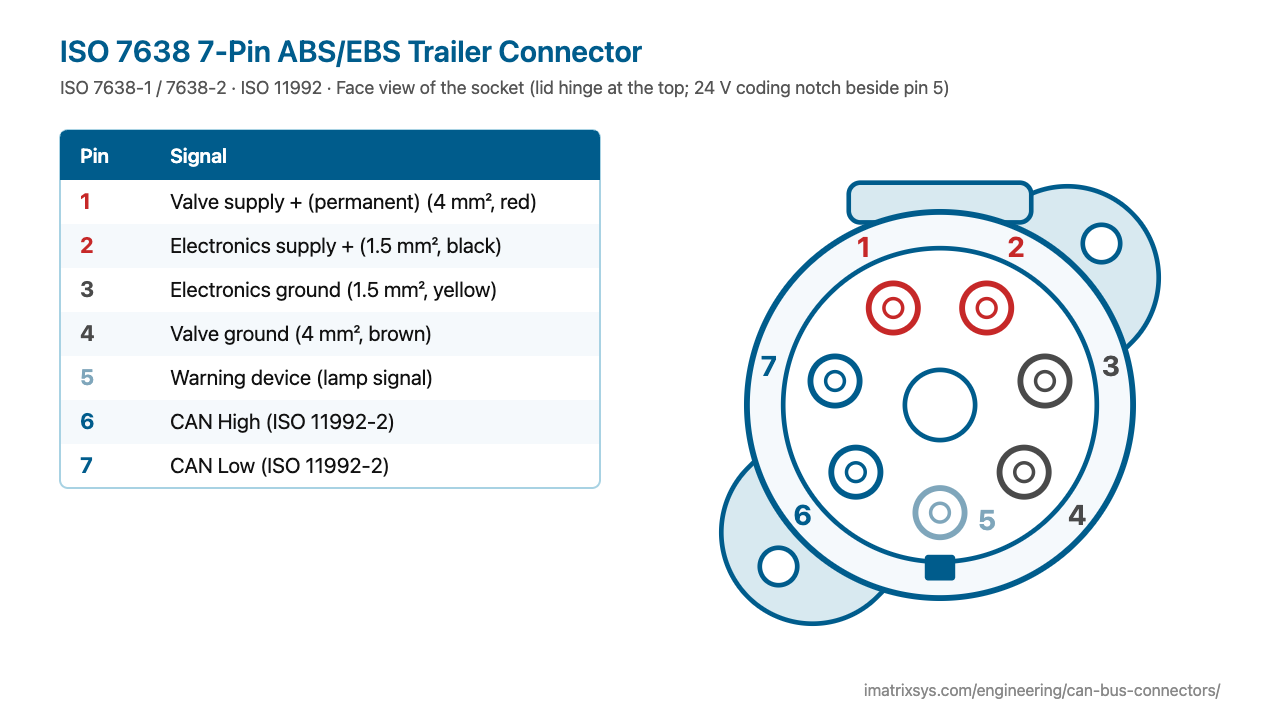
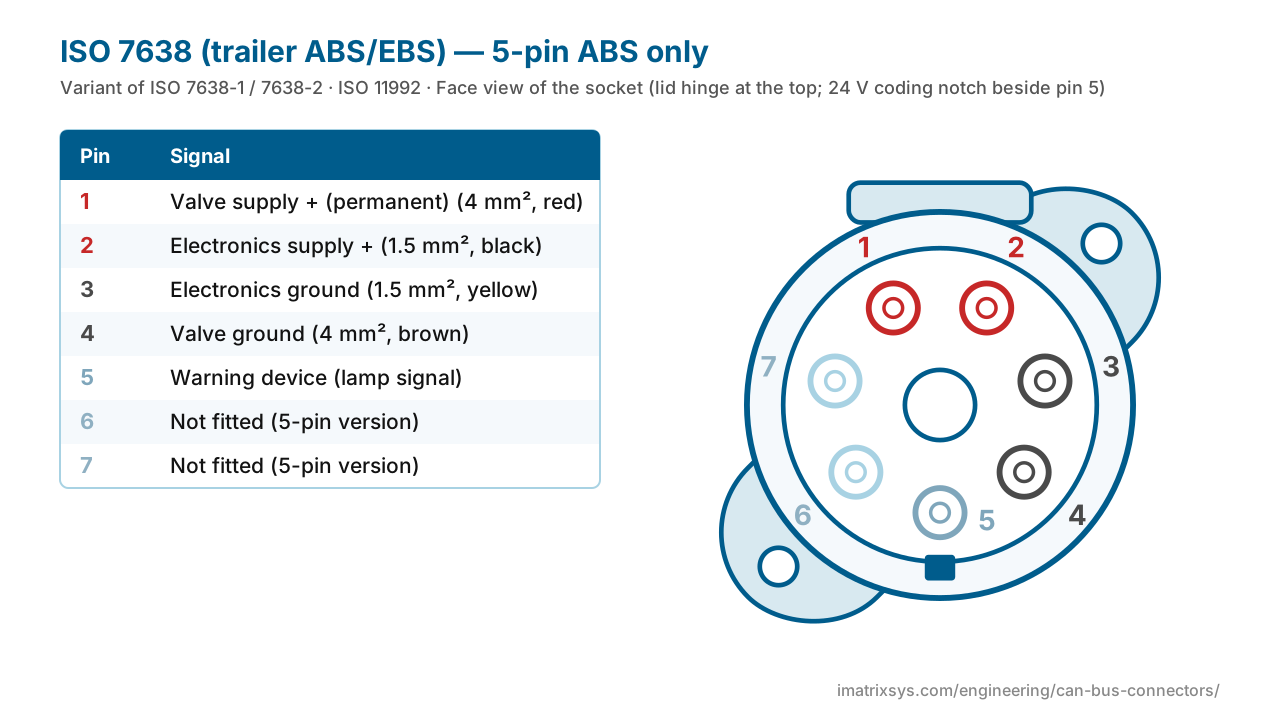
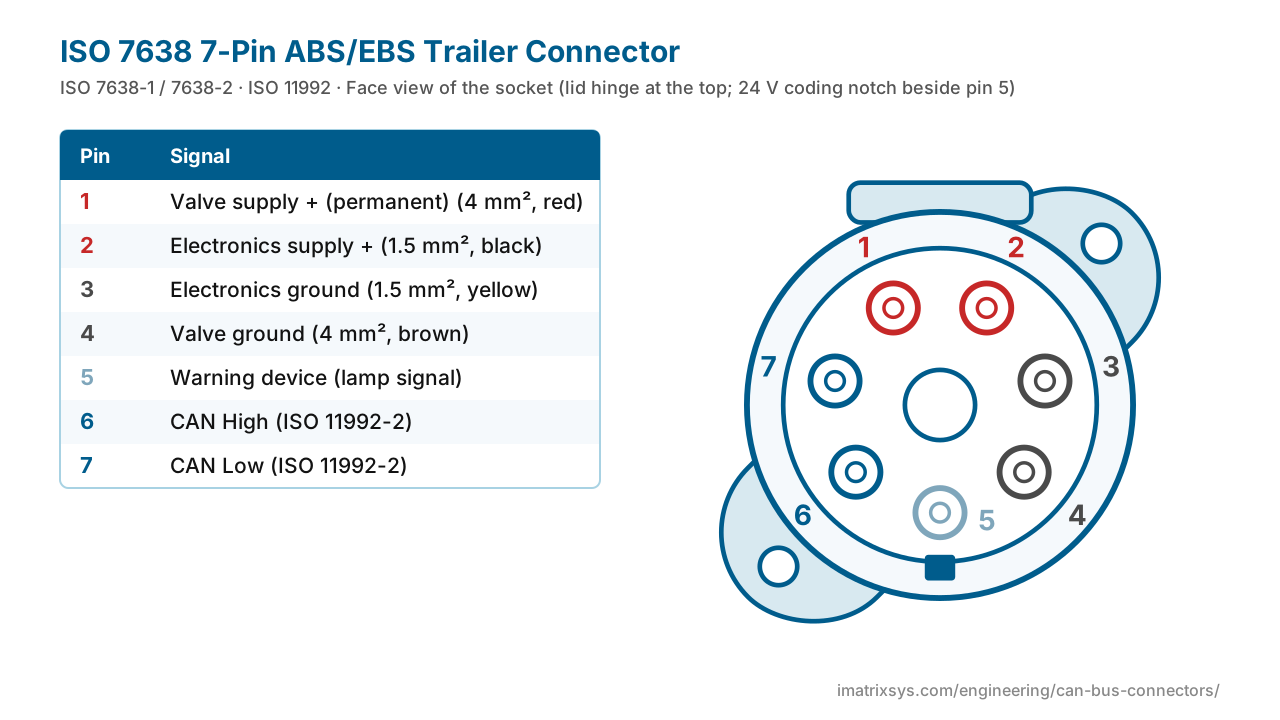
Seven equal contacts sit on one ring, numbered clockwise from about 11 o’clock on the socket face, with pin 5 at the bottom beside the coding notch. Pins 6 and 7 carry ISO 11992 CAN — not ordinary CAN. Switch to the 5-pin ABS-only version to see the difference, or to the plug face for the mirror image.
Face view of the socket (lid hinge at the top; 24 V coding notch beside pin 5)
| Pin | Signal |
|---|---|
| 1 | Valve supply + (permanent) — 4 mm², red |
| 2 | Electronics supply + — 1.5 mm², black |
| 3 | Electronics ground — 1.5 mm², yellow |
| 4 | Valve ground — 4 mm², brown |
| 5 | Warning device (lamp signal) — 1.5 mm², white; open circuit when OK |
| 6 | CAN High (ISO 11992-2) — 1.5 mm², white/green |
| 7 | CAN Low (ISO 11992-2) — 1.5 mm², white/brown |
| Standards | ISO 7638-1 (24 V) and ISO 7638-2 (12 V); CAN per ISO 11992-1 and -2 |
|---|---|
| Power | Pin 1 valve supply + and pin 4 valve ground on 4 mm² wire; pin 2 electronics + and pin 3 electronics ground on 1.5 mm² |
| Colours | 1 red, 2 black, 3 yellow, 4 brown, 5 white, 6 white/green, 7 white/brown |
| CAN | ISO 11992-2 on pins 6 / 7: point-to-point, 125 kbit/s |
| Termination | Inside each transceiver — no 120 Ω terminators |
| Versions | 7-pin (ABS / EBS) and 5-pin (ABS only, no CAN), at 12 V and 24 V |
ISO 7638 was first published in 1985 as the connector for trailer anti-lock brakes. In 1997 it was split into ISO 7638-1 for 24 V vehicles and ISO 7638-2 for 12 V, with housings coded so the two cannot be mated by mistake; it was revised in 2003 and the current edition dates from 2018. The standard also defines a park socket that holds the plug when the trailer is uncoupled.
When electronically controlled braking arrived, the tractor and trailer needed to exchange data, not just power. ISO 11992 (first editions 1998, revised 2003) defines that link: part 1 the physical and data-link layers, part 2 the brake and running-gear messages carried on ISO 7638 pins 6 and 7, part 3 other equipment, and part 4 diagnostics. European type-approval rules list which ISO 11992-2 messages are mandatory — such as brake demand and warning requests — and which are optional, such as brake-lining wear, tyre pressure, axle load and brake temperature.
The frames on pins 6 and 7 are standard CAN frames with J1939-style identifiers, but the physical layer is different from the ISO 11898-2 high-speed CAN on a diagnostic port:
To read it with a normal CAN interface you need an ISO 11992 transceiver or a converter, such as the PEAK-System PCAN-B10011S, between your tool and the connector.
The 24 V 15-pin lighting connector also carries ISO 11992 CAN — the part 3 network for equipment other than the brakes — so the brake data always stays on ISO 7638:
| ISO 12098 pin | Function | Wire |
|---|---|---|
| 13 | Common return for the data lines | 2.5 mm², white/red |
| 14 | CAN High (ISO 11992-3) | 1.5 mm², white/green |
| 15 | CAN Low (ISO 11992-3) | 1.5 mm², white/brown |
US and Canadian trailers use the round 7-way SAE J560 connector instead, and it has no CAN. Pin 7 (blue) is the continuous ABS power circuit, and the trailer ABS reports faults to the cab as power-line carrier on that wire (PLC4TRUCKS, SAE J2497); in-cab trailer ABS warning lamps became mandatory there on 1 March 2001.
Choose any two connectors to get a pin-to-pin wiring diagram, with wire colours, which pins to leave unconnected, and the power and termination warnings that matter. Hover a wire to trace it.
Pick two connectors to draw the wiring. (Needs JavaScript.)
Pin 1 valve supply + (4 mm², red), pin 2 electronics supply + (black), pin 3 electronics ground (yellow), pin 4 valve ground (4 mm², brown), pin 5 warning lamp (white), pin 6 CAN High (white/green) and pin 7 CAN Low (white/brown). Pins 2, 3, 5, 6 and 7 use 1.5 mm² wire.
The 5-pin version carries ABS power and the warning lamp only. The 7-pin version adds the ISO 11992 CAN pair on pins 6 and 7, which electronic braking (EBS) needs.
ISO 7638-1 is the 24 V connector and ISO 7638-2 the 12 V one. The contact functions are the same, but the housings are coded differently so they cannot be cross-connected.
It uses CAN frames and J1939-style messages, but on a point-to-point, fault-tolerant physical layer at 125 kbit/s whose voltages follow the battery supply. A standard CAN tool needs an ISO 11992 transceiver or converter.
No. ISO 11992 is not a terminated high-speed bus: each transceiver contains its own resistor network.
No. Its CAN on pins 14 and 15 is ISO 11992-3 for equipment other than the brakes. Brake data stays on the ISO 7638 connector.
Not as standard. US and Canadian trailers use the SAE J560 7-way plug and send ABS status as power-line carrier (PLC4TRUCKS, SAE J2497) on the blue ABS power wire.
Sources: Erich Jaeger: ISO 7638-1 and -2; Hella: ABS/EBS plug system to ISO 7638; Haldex drawing 844_001_000_2 (ISO 7638 socket); ISO 7638-1:2018; ISO 11992-1:2003 sample pages; PEAK-System PCAN-B10011S (ISO 11992 converter); CAN Newsletter: ISO 11992-1 transceiver; Erich Jaeger: ISO 12098; Regulation (EU) 2015/68, Annex XII, Appendix 1; Trailer/Body Builders: TMC picks trailer communication link; Wikipedia: ISO standards for trailer connectors.
Last reviewed 2026-10-28. Pin assignments follow ISO 7638-1 / 7638-2 · ISO 11992; OEM variants are noted where we could verify them. Spotted an error? Tell us.
iMatrix designs and builds CAN, J1939 and OBD-II harnesses for OEMs and fleets, and our FleetConnect telematics devices plug straight into the 9-pin and OBD-II ports. Tell us the two ends and the quantity.