Catch the drift before the load does.

Continuous reefer-core temperature reporting every 30 seconds. Alerts fire the moment you drift outside the safe band — not the next morning, not on the invoice dispute, not when your customer rejects the shipment at the dock.

Core cargo temperature, on the same timeline as GPS.

Continuous core readings

Neo-1P probe sits in the cargo core, reports every 30 seconds via BLE to the FC-201 or FC-501 in the cab, then over cellular to iMatrix Cloud.

🚨

Threshold alerts in seconds

Configurable alarm bands per load. SMS, email, push, or webhook — you pick who gets woken up at 2 a.m. and who sees the morning report.

📍

Correlated with location

Every temperature reading is tagged with GPS coordinates and timestamp. When a load goes out of band, you know exactly where and when.

A reefer that "looks right" at the dock can still spoil the load.

Traditional reefer monitoring gives you a temperature reading at loading and at delivery. Anything that happens in between — a compressor that stalls on a 98°F afternoon, a door left cracked at a stop, a defrost cycle that goes long — only shows up if the cargo itself shows visible damage. By then it's too late.

iMatrix changes the economics. A probe in the cargo core and a gateway on the tractor gives you a reading every 30 seconds for the entire run. The moment the bay drifts outside your configured band, an alert fires to dispatch with the exact location and the current reading. You have time to call the driver, reroute, or pull ahead to a swap yard — before the load is compromised.

Every reading, every door event, on one timeline.

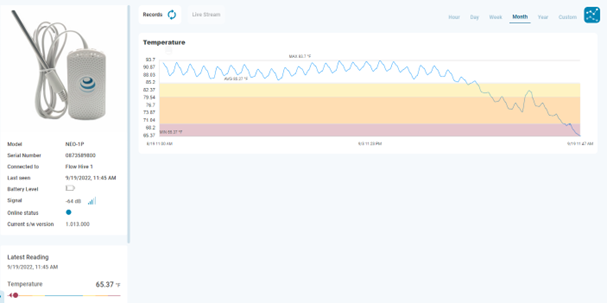
Open iMatrix Cloud and you see the cargo core temperature trended over the entire run. The yellow caution band and pink breach band are user-configured per commodity — the moment a reading enters either zone, alerts fire by SMS, email, push, or webhook. Sentry-1 door events ride the same timeline so you can see the temperature spike that came from the dock-stop with the doors open.

iMatrix Cloud temperature time-series graph showing a Neo-1P probe with high (yellow) and low (pink) alert threshold bands
iMatrix Cloud. Neo-1P probe trended hour / day / week / month / year / custom. Min, average, and max annotated. Alert bands in yellow (caution) and pink (breach) trigger notifications the moment a reading crosses into either zone.

Three devices. One timeline.

Neo sensors broadcast over BLE to the FC-201 or FC-501 already in the cab as the fleet's telematics gateway. One device, one cellular eSIM, one timeline — no separate Micro Gateway, no second SIM.

Pick the gateway for the deployment.

Three ways to backhaul reefer-trailer sensor data to iMatrix Cloud — match the choice to whether you own the tractor, the trailer, or both, and how integrated you want your telematics + cold-chain stack.

Built for FSMA Sanitary Transport.

21 CFR 1.908 — Sanitary Transport of Human & Animal Food

FSMA requires shippers, carriers, and receivers to document that temperature-sensitive cargo was kept at its required temperature throughout transport. iMatrix Cloud retains every probe reading, door event, and GPS ping for the life of the vehicle. One-click signed PDF exports are formatted for the way auditors actually want to consume records — per shipment, per lot, per SKU.

Produce Traceability Initiative (PTI)

GTIN + lot + timestamp-correlated temperature records. When a recall comes, you know which load went where and under what conditions.

Customer QA audits

Big-box grocers, food-service distributors, and pharmaceutical shippers increasingly require traceable temperature records as part of carrier vetting. NIST-calibrated probes + continuous monitoring + signed exports gives you an answer when the question comes.
What a reefer trailer actually gets.

Also monitoring cold storage at your facilities?

In-transit temperature is telematics — Neo sensors aggregated by the FC-201 or FC-501 in the cab. Facility-side cold storage is environmental monitoring — same Neo sensors, but aggregated by the Micro Gateway because there's no vehicle to ride on. Same catalog, different aggregator.

Environmental Use Cases →