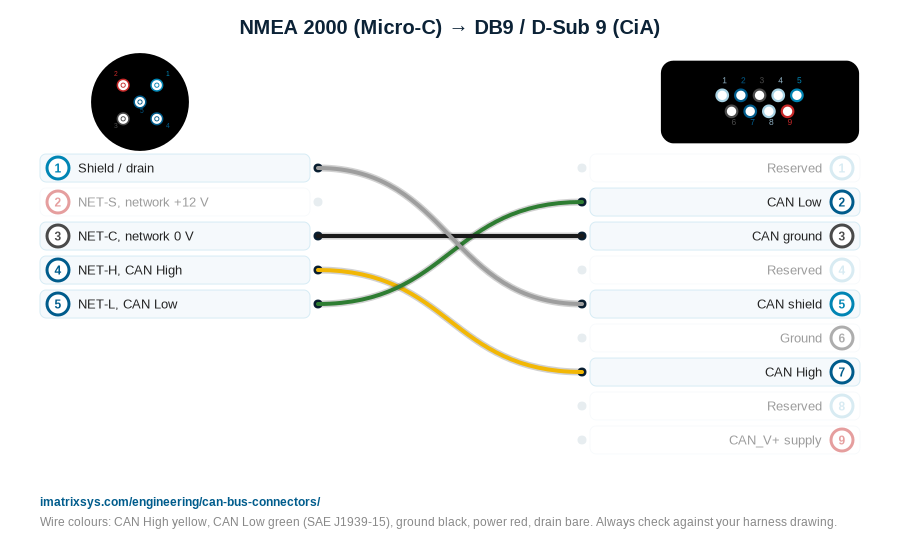
Pin to pin, NMEA 2000 (Micro-C) → DB9 / D-Sub 9 (CiA): pin 4 → pin 7 (CAN High); pin 5 → pin 2 (CAN Low); pin 3 → pin 3 (Ground reference); pin 1 → pin 5 (Shield / drain).
For reading a boat's NMEA 2000 backbone with a DB9 CAN interface. NMEA 2000 is CAN at 250 kbit/s on a 5-pin Micro-C connector. Power is not carried in this diagram; the interactive converter can add it after you check the voltages.
| NMEA 2000 (Micro-C) | Signal / wire | DB9 / D-Sub 9 (CiA) |
|---|---|---|
| 4 | CAN High | 7 |
| 5 | CAN Low | 2 |
| 3 | Ground reference | 3 |
| 1 | Shield / drain | 5 |
Full pinouts, variants and sources are on each connector's page.
Wire NMEA 2000 (Micro-C) pin 4 to DB9 / D-Sub 9 (CiA) pin 7 (CAN High); NMEA 2000 (Micro-C) pin 5 to DB9 / D-Sub 9 (CiA) pin 2 (CAN Low); NMEA 2000 (Micro-C) pin 3 to DB9 / D-Sub 9 (CiA) pin 3 (Ground reference); NMEA 2000 (Micro-C) pin 1 to DB9 / D-Sub 9 (CiA) pin 5 (Shield / drain). Leave every other pin unconnected.
On NMEA 2000, connect a device through a tee and a drop cable of at most 6 m (78 m of drops in total). The two 120 Ω terminators belong only at the ends of the backbone, and the backbone itself must be powered or no data flows. An adapter does not terminate the bus. A healthy network measures about 60 Ω between CAN High and CAN Low with power off (two 120 Ω terminators). Use twisted pair for High and Low.
Power (NMEA 2000 (Micro-C) pin 2, DB9 / D-Sub 9 (CiA) pin 9) is left unconnected. Tick “Carry power” to wire it, after checking voltages.
NMEA 2000 Micro-C Connector: 250 kbit/s. DB9 (D-Sub 9) CAN — CiA 303-1: Any (classic CAN & CAN FD). Set the interface to the bit rate of the network it connects to; a mismatch shows up as error frames or a bus-off, not as data.
Generated from the same pin data and rules as the interactive converter; pin assignments follow NMEA 2000 / IEC 61162-3 and CiA 303-1 / CiA 106 (sources on each connector page). Last reviewed 2026-11-27. Spotted an error? Tell us.
Wiring diagrams: J1939 9-pin → DB9 · J1939 Type II (green) → DB9 · OBD-II → DB9 · J1939 9-pin → OBD-II · 6-pin J1708 → 9-pin J1939 · M12 → DB9 · RJ45 → DB9 · 3-pin Deutsch → DB9
iMatrix designs and builds CAN, J1939 and OBD-II harnesses for OEMs and fleets, and our FleetConnect telematics devices plug straight into the 9-pin and OBD-II ports. Tell us the two ends and the quantity.