ISO/IEC 17025 · Environmental Monitoring for Labs

Environmental records an assessor can follow from the sensor to the certificate.

iMatrix connects NIST-traceable Neo sensors, the Micro Gateway and iMatrix Cloud into one documented data path. For example, a reagent refrigerator held at 2–8 °C is logged continuously, alarmed in three tiers, and tied to the serial number on its calibration certificate.

See product pageLaboratory Kit, 4 devices
3+ pointsMulti-point calibration
About 2 weeksAnnual recertification

Four links from the instrument to the report.

An assessor will ask how a reading gets from the instrument to the report. Here is the path a reading takes.

  1. 1 · NEO NIST sensor

    Measures and stores

    Neo sensors are data loggers. The NEO-1DP holds up to 100,000 readings in on-device memory.

  2. 2 · Micro Gateway

    Relays BLE to Wi-Fi

    Scans for iMatrix sensors over Bluetooth 5.0 and sends their readings to iMatrix Cloud over 2.4 or 5 GHz Wi-Fi, encrypted end to end.

  3. 3 · iMatrix Cloud

    Records, alarms, archives

    Stores the time series, evaluates every threshold, and archives each signed calibration certificate under the sensor serial number.

  4. 4 · People

    Web UI, Mobile App, Notifications

    Quality staff review trends in the browser. Technicians get alarms on their phones and check the sensor at the bench.

A typical small testing lab, sensor by sensor.

Where each sensor and Micro Gateway goes in a lab with seven controlled locations. The reagent refrigerator gets a probe sensor with its base unit outside the door. The balance room gets a display sensor, so staff can confirm conditions before every weighing.

Example floor plan of a small testing lab with nine numbered monitoring points and two Micro Gateways. The numbered points are listed in the table below.SAMPLE RECEIVINGTESTING LABBALANCE ROOMREAGENT & MEDIA STORAGECORRIDORQA OFFICESample refrigerator2–8 °C1Retained samples15–25 °C2Test bench20–25 °C3Water bath37.0 ± 1.0 °C4Incubator30 ± 2 °C5Analytical balance20 ± 2 °C6Reagent refrigerator2–8 °C7Freezer−20 °C8Test bench B: covered by sensor 39Reagent room doorG1Micro Gateway on UPS-backed USBG2Second data pathQuality manager: Web UI on the office PC

Example sensor placement in a small testing lab. Coverage circles are illustrative; indoor range depends on walls and refrigerator doors.

#LocationDeviceWhy this placement
1Sample refrigeratorNEO-1P NISTProbe in a glycol bottle reads sample temperature, not door-open air
2Retained samples shelvingNEO-1 NISTRoom storage condition for retained samples
3Testing lab, bench heightNEO-1D NISTStaff read temperature and RH on the display before starting a test
4Water bathNEO-1P NISTSubmersible probe in the bath water; base unit stays dry
5IncubatorNEO-1DP NISTProbe inside the chamber, ambient temperature and RH outside it
6Balance roomNEO-1D NISTWeighing conditions confirmed at the door; away from HVAC vents
7Reagent refrigeratorNEO-1P NISTCritical storage, in range of both Gateways
8−20 °C freezerNEO-1P NISTProbe in the freezer core, high alarm at −15 °C
9Reagent room doorSentry-1Explains short temperature rises and flags a door left open
G1CorridorMicro GatewayCentral position, UPS-backed USB outlet
G2Reagent storageMicro GatewaySecond data path for the storage and balance rooms

Limits are examples; the lab sets its own from each method.

Probe placement

2–8 °CBase unitoutsideDoor gasketProbe inglycol bottle

The probe sits in a glycol-filled bottle on the middle shelf, so a door opening does not swing the reading. The cable runs through the door gasket to the base unit outside.

Devices for this example

  • 4 × NEO-1P NISTSee product page each
  • 2 × NEO-1D NISTSee product page each
  • 1 × NEO-1DP NISTSee product page each
  • 1 × NEO-1 NISTSee product page each
  • 1 × Sentry-1See product page each
  • 2 × Micro GatewaySee product page each

Add an iMatrix Cloud plan and annual recertification. Ask for a quote for your lab.

Four NIST-certified Neo sensors, one for each kind of controlled space.

Every NIST variant uses the same hardware as its standard Neo model. The difference is the multi-point calibration and the signed certificate. Use a probe model wherever the controlled quantity is inside an enclosure.

NIST Certified NEO-1 NIST sensor

NEO-1 NIST

See product page

Temperature, humidity, dew point, heat index and VPD.

Typical location: Lab ambient, balance rooms, sample storage
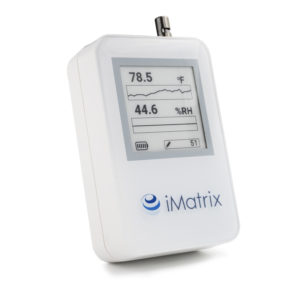
NIST Certified NEO-1D NIST sensor

NEO-1D NIST

See product page

Everything on the NEO-1, plus an e-ink display.

Typical location: Benches where staff read conditions before a test
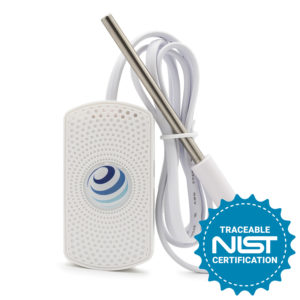
NEO-1P NIST sensor

NEO-1P NIST

See product page

Submersible stainless-steel temperature probe, −40 to 70 °C.

Typical location: Refrigerators, freezers, water baths
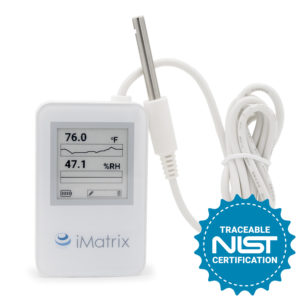
NEO-1DP NIST sensor

NEO-1DP NIST

See product page

Probe temperature (−40 to 70 °C) plus ambient temperature and humidity, with an e-ink display.

Typical location: Stability and environmental chambers

See each product page for full specifications, and our sample certificate for what each sensor ships with.

Choose the certificate your lab needs.

Our NIST sensors ship with NIST-traceable calibration, which is not an accredited certificate. If your methods, assessor or customers require an accredited certificate, ask for ISO/IEC 17025 accredited calibration when you order, for an additional $25 per sensor.

NIST-traceable calibration
Standard on NIST sensors
ISO/IEC 17025 accredited calibration
Available on request
Traceable to NISTYesYes
Multi-point readings on the certificateYesYes
Accreditation mark on the certificateNoYes
Measurement uncertainties on the certificateNoYes, for accredited measurements
Best forMost monitoring, quality and audit recordsLabs and customers that require an accredited certificate
PriceIncluded in the NIST sensor priceNIST sensor price + $25 per sensor. Contact sales to order

We confirm which measurements are covered by the accredited calibration with your quote.

The link that sends every reading to iMatrix Cloud.

The Micro Gateway is a USB dongle that bridges sensors to the site Wi-Fi. It needs no pairing: it finds iMatrix sensors in range and starts uploading. One Micro Gateway serves a small site of up to about 50 sensors.

It does not measure anything, so it carries no calibration certificate. What the lab must show instead is that the data path works and that an outage cannot pass unnoticed.

See product page · Micro Gateway details →

Two Gateways for critical storage

The Laboratory Kit ships with two Micro Gateways as a redundant pair. Power each one from a UPS-backed outlet, never from a PC that sleeps or reboots for updates.

Three alarm tiers above and below, so staff act before results are at risk.

024681012 AM6 AM12 PM6 PMAlarm 8.0Alarm 2.0

Illustrative example: a reagent refrigerator over one day, with alarm limits drawn on the chart.

Six independently armed limits

Advisory, Warning and Alarm on both the high and low side. Any tier can be switched off. A −20 °C freezer, for example, may use a high Advisory and Alarm with no low limits.

Dwell time against nuisance alarms

A value must stay past a limit for the dwell time before it triggers. A 300-second dwell keeps a routine door opening from paging the on-call technician.

Set limits inside the tolerance

Set thresholds inside the method's tolerance, leaving room for measurement uncertainty, so the alarm arrives before a real excursion does.

The same sensor, at the bench

The free iMatrix app shows the sensor's status, latest readings and charts with limits drawn in, so a technician can see whether the problem is the space or the system. About the Mobile App →

What ISO/IEC 17025 asks for, and where iMatrix helps.

ISO/IEC 17025 is the international standard testing and calibration labs are accredited against, and its requirements are organized in numbered clauses. Assessors check labs clause by clause, so quality managers often want to see exactly which ones a monitoring system supports.

View the clause-by-clause map
ClauseThe lab must showHow iMatrix supports itThe lab's part
6.3Environmental conditions are monitored and recordedNIST-certified sensors at each controlled location, continuous logging, tiered thresholdsDefine the conditions each method requires
6.4.7A defined calibration programmeAnnual recertification (NIST-RECERT-01) in about two weeks, with staggered scheduling for bulk ordersSet the interval and accept each result
6.4.10Intermediate checks between calibrationsSensor readings available to compare against a referenceRun and record checks against the lab's own reference thermometer
6.4.13Equipment records with calibration statusCertificates archived under each sensor serial numberKeep the equipment list and track due dates
6.5Metrological traceabilityNIST-traceable calibration as standard; ISO/IEC 17025 accredited calibration, with measurement uncertainties, available on requestReview each certificate against the lab's criteria
7.5 / 8.4Records that are complete, retrievable and protectedTime-series storage in iMatrix CloudConfirm retention and retrieval meet the lab's procedure
7.10Nonconforming work is detected and acted onThree-tier alarms with dwell timeDefine the response and record each event
7.11Data integrity and control of softwareSensor data encrypted end to end from device to iMatrix CloudValidate the data path and software for the intended use

Guidance only. iMatrix Systems is not an accreditation body or a calibration lab, and using this system does not by itself meet any requirement. The lab and its assessor decide what satisfies each clause.

Setting up for an assessment, in order

  1. 1

    Define the limits each test method requires, by location.

  2. 2

    Place the sensors, with probe models inside refrigerators, freezers and baths.

  3. 3

    Set thresholds inside each tolerance, allowing for uncertainty.

  4. 4

    Register every sensor and Gateway in the equipment list by serial number.

  5. 5

    Review and accept each certificate against the lab's criteria.

  6. 6

    Validate the data path, including an unplugged-Gateway outage test.

  7. 7

    Run intermediate checks quarterly and record the results.

  8. 8

    Recalibrate annually, rotating spare sensors in during the two-week turnaround.

Built for a lab with a handful of controlled spaces.

ENV-KIT-LAB

Laboratory Kit

See product page

1 × NEO-1D NIST, 1 × NEO-1P NIST and 2 × Micro Gateway as a redundant pair.

Add to Cart →

NIST-RECERT-01

Annual recertification

Contact sales

About two weeks at Cal-Tek Company, with a new signed certificate archived to iMatrix Cloud.

Start a recertification →

iMatrix Cloud

Cloud plan

See pricing

Time-series storage, alerts and the certificate archive.

Environmental pricing →

Frequently asked questions

Are the certificates accredited?

Standard NIST sensors ship with a NIST-traceable certificate, which is not an accredited certificate. If your lab requires one, ask for ISO/IEC 17025 accredited calibration, an additional $25 per sensor, which adds the accreditation mark and measurement uncertainties to the certificate.

What happens to monitoring while a sensor is out for recalibration?

Recertification takes about two weeks. The lab should rotate a spare calibrated sensor into the location. For bulk orders, iMatrix can stagger shipments so no location goes uncovered.

Does using iMatrix make a lab ISO/IEC 17025 compliant?

No. The system supports specific requirements, but the lab remains responsible for its procedures, validation and accreditation. The assessor decides whether the requirements are met.

Send us your controlled spaces and their limits.

We will come back with a sensor and Gateway plan for your lab.

Talk to Our Team →